Friday, June 4, 2010

More on BP.


A Petroleum engineer describes how BP is doing the minimum to clean up (as expected) and suggests what they should be doing. His suggestions summarized:
  1. Stop releasing dispersants.
  2. Mobilize every possible tanker to siphon up crude from as close to the leak points as possible.
  3. Restart work on the second pressure relief well.

Robert Reich discusses how it is both possible and necessary for BP to be placed under temporary receivership of the U.S. government. His reasons (summarized, again) why it must be done:
  1. We are not getting the truth from BP.
  2. We have no way to be sure BP is devoting enough resources to stopping the gusher.
  3. BP’s new strategy for stopping the gusher is highly risky.
  4. Right now, the U.S. government has no authority to force BP to adopt a different strategy.
  5. The President is not legally in charge.
Again, it's worth reading in full both the problem as he sees it and the legal precedent for taking over.

One thing that kind of bugs me about the public response to the disaster is the idea that we can punish the BP corporation by not shopping at the BP gas station and instead shopping at the gas station across the street. BP's profit is determined largely by the cost of oil on a globally traded market, and boycotts of individual gas stations will tend to cause more harm to the proprietor of the station (and the benefit will largely be to the station across the street) than to the corporation at large. If you really want to cut into the BP's profits, you need to cut into the entire oil industry.

In addition to the more obvious pigouvian incentive of the carbon tax, a land tax will also reduce our overall oil consumption:

We spend a lot of money heating and cooling older homes many miles from where people actually work. People commute long distances -- most of them via private cars because there aren't viable alternatives. Why do they live so far from their work? Usually because they can't afford to live closer.

The selling price of most housing within a commutable distance of any vibrant city is mostly land value. And most people don't know it.

Also, xkcd speculates on the worst case scenario:
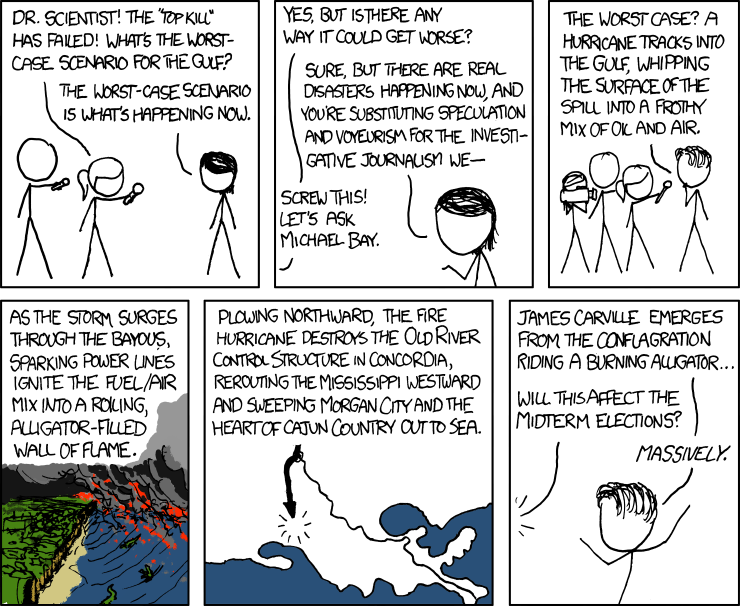
Click to enlarge, there's a hurricane of fire and alligators.

Oh, and as long as we've made it to the comedic section of this post, you can also read about how Sarah Palin is trying to reconcile this disaster with the "Drill, Baby, Drill" slogan, because it's funny.

Tuesday, May 25, 2010

There's a lot to work through as oil still flows into the Gulf of Mexico.

David Friedman opines that Obama missed an opportunity to energize the country similar to Bush's reaction to 9/11. Aside from the rather obvious observation that this hasn't been nearly as seismic an event on the psyche of the country as 9/11 was, I do appreciate the oft-read columnist endorsing the pigouvian gas tax.

Ready to be terrified? Think about what happens when hurricaine season hits the Gulf of Mexico. Firstly, the darker surface of the water has the effect of absorbing sunlight, creating more heat in the gulf and thus more intense storms. Aside from that, I'd merely worry that storms could theoretically throw oil onto the usually-hit coastal cities. Maybe THAT could be the seismic event Friedman was hoping for.

Ed Glaeser laments that the existing climate bill (The American Power Act) isn't as simple, aesthetic, and efficient as a carbon tax. Of course, the bill is designed to pass (and the word "tax" is anathema), not to be ideally effective. He concludes that "it is hard to relish either this ornate piece of legislation or the prospect of inaction on global emissions."

It is also worth reading about whether the tea party's agenda – and their newly anointed libertarian leader – is mired in racism.

Friday, May 21, 2010

Misplaced priorities, again

Terrorism was a name based on people's psychological reactions to a set of events, and if they're concerned about terrorism, they might ask what causes terror, and how can we stop people from being terrified...

In raw numbers, these are very tiny accidents. We already know, for example, that in the United States more people have died as a result of not taking airplanes because they're scared and driving on highways than were killed in 9/11.

Not the least interesting thing to be found in this TED talk (this quote at about minute 24).

Dan Gilbert asks later, "which problem would you solve, terrorism or poverty?" And though the host (and, as it generally appears, the audience) agrees that poverty would be a more productive thing to solve, there seems to be no particular recognition that poverty could be a causing factor of terrorism, making it of course even a more productive solution than originally intended.

Also, one questioner near the end challenges the rather unsympathetic presentation of those who buy lottery tickets, indicating that from his interviewing of lottery ticket buyers, they buy it not because they think they're going to win, they buy it because it makes them feel good, and they get a serotonin release. My response, perhaps a little more direct than Gilbert (since I have the freedom of not confronting the person directly), is that: if the person really believed they weren't going to win, they wouldn't get the serotonin response. The serotonin response is an indication that they still believe they could win.

Thursday, May 20, 2010

Some interesting charts at Sociological Images question whether Americans truly are more individualistic than other nations. Their findings are that, when you define individualism as "giving priority to personal liberty," you find that many other unexpected countries are more individualistic.

Some possible explanations are provided by the researcher, Claude Fischer:
(1) Americans aren’t really individualistic (anymore).

(2) Americans means something else by individualism (like freedom from government or pulling yourself up by your bootstraps). Fischer thinks that these are different values, though: anti-statism and laissez-faire, pro-business economics.

(3) Americans are individualistic, but they are also religious and sometimes religion outweighs individualism. If that’s so, Fischer argues, then maybe it is true that we’re not that individualistic.

(4) American individualism is found not in people’s opinions, but in how we organize our society. Fischer calls this “undemocratic libertarianism.”

Finally, (5) maybe what is meant by individualism is really voluntarism, the right to leave and join groups as we see fit.

I might be curious if her findings were the same if, when she asked questions such as “In general, would you say that people should obey the law without exception, or are there exceptional occasions on which people should follow their consciences even if it means breaking the law?” she were to replace the word "people" with "you" whenever it occurs, i.e., "would you say that you should obey the law without exception...?" There's a chance that we might find, when asking those questions, more of what we mean by American individualism (i.e., inherent cognitive biases).

I'd also be curious if there was a way to control for priming. Were the people who were asked the question “People should support their country even if the country is in the wrong,” most recently reminded of the Iraq invasion, the TARP bailout, or the Health Care Bill? I imagine, too, that if we were able to control for such priming, you'd find that the responses might split down demographic or party lines.

Wednesday, May 19, 2010

Fred Foldvary evaluates who is liable – and who should be liable – for the Deepwater Horizon accident.

It is not a puzzle why the planet is being plundered and ruined. The plunder is being subsidized by governments worldwide. These giant corporations have the political clout to obtain tremendous subsidies, and democracy is not stopping it. Something is terribly wrong as the world is falling apart, and governments are causing this by their failure to protect the property rights of the people.

Tuesday, May 18, 2010

Who gets the revenue of auctioned carbon permits?

The Kerry-Lieberman "American Power Act," also known as the cap and trade climate bill, would initially auction only 24.8% of the carbon allowances.

The Brookings Institution has broken down who would get that revenue. Summarized:

None of the auction revenue is used to reduce high marginal tax rates on income or capital, although some revenue is used for “consumer relief,” which includes a tax credit for households above 150 percent of the poverty line, which is phased out starting at 250 percent of the poverty line. Some of the auction revenue is also used for a “universal refund,” which is a lump-sum payment made to all eligible taxpayers, adjusted for family size.

Only a small percentage of the allowance value is used for deficit reduction.

Monday, May 17, 2010

Probably time to stop driving.

Once your company starts selling stock on a publicly traded market, your company's chief end becomes "make money for shareholders." Your shareholders can sue you if you don't. If you, as a CEO, decide to place the sanctity of nature above your profit, you are likely to be in hot water with your shareholders unless you can make a convincing case that the good PR will eventually reap rewards in future profits. If lawmakers are considering regulating measures that would cost your corporation money, it is your legal duty to your shareholders to fight it.

Clearly, the word for this sort of social structure is "horrible," but it is the existing structure of corporations that we tolerate today. Keeping that in mind, how can we possibly react to BP when they have a record of fighting regulation and as they seem to be preparing for only as much cleanup is required to maintain their business's image? If you were a legislator with the opportunity to speak with BP's CEO in a committee hearing, what would you say?

I might ask Tony Hayward if he recalls the assumptions of perfect markets, those that he must have learned in introductory economics. Surely he has fully internalized the theories of markets that rely on these assumptions, if he does not keep in mind their requisite assumptions. I might ask if he recalls the meaning of the assumption of 'perfect information,' that people deciding which products to buy understand fully the products they have available to buy, the processes used to create them, and the businesses that supply them. I would then ask about BP's advertising, in that they purport to be an environmentally friendly oil company, and whether or not it represents their actual practices. I would ask how they could be trusted with free market capitalism when they can use advertising to so easily undermine its requirements.

I'd also tell him that it's probably not the time to mix up gulfs and oceans in public statements.

Image is from Andy Singer.