Not sure anyone is a subscriber or reader aside from personal friends. Thank you for reading and commenting and subscribing and what have you. It has been edifying!
Though I imagine the technology is nearly the same, I'm retiring the blogspot account (not deleting, just retiring its use) and posting things on tumblr, which seems to encourage the sort of content that my schedule allows moreso lately. That is, less so paragraphs of commentary, moreso sharing things I find interesting with minimal comment, which is sort of what the Pigouist had turned into. Also, I'm using this transition to hopefully expand into other kinds of content aside from the environment/economics intersection, including, hopefully, music I write or have participated in, or other types of content (vlogs? anyway).
If you use an RSS reader, you can subscribe to the tumblr here.
Again, thanks.
Friday, May 27, 2011

Sunday, April 17, 2011
Misdiagnosed Ills
Much like how you don't notice the inefficiency of urban design until you have to buy gas, you often don't realize how expensive it is to maintain roads until you have to get alignments more often:
Unfortunately, when the cost is only paid at the gas pump or at the repair shop, it's harder to identify that the cause is systemic.
Forty-one percent of Cleveland-area highways and major roads were in "poor or mediocre condition," based on 2008 reports to the Federal Highway Administration, TRIP reported.
The pock-marked routes result in $295 in added costs yearly for the average Cleveland driver, the report said.
Unfortunately, when the cost is only paid at the gas pump or at the repair shop, it's harder to identify that the cause is systemic.
Tuesday, March 15, 2011
Two articles in Slate
The first is on the bizarre double standard regarding how we react to catastrophes in the nuclear industry versus fossil-fuel industries:
The second is on why ethanol won't work either:
Less than a year ago, a drilling rig exploded off the coast of the United States, killing 11 workers and pouring 4 million barrels of oil into the Gulf of Mexico. No natural disaster caused this tragedy. It was entirely man-made. President Obama halted deep-water drilling but lifted the moratorium less than six months later. On Friday, while fielding questions about Japan's nuclear reactors, he proudly noted that his administration, under new, stricter rules, had "approved more than 35 new offshore drilling permits."
That's how we deal with tragedies in the oil business. Accidents happen. People die. Pollution spreads. We don't abandon oil. We study what went wrong, try to fix it, and move on.
The second is on why ethanol won't work either:
They started to change their minds as a stream of research showed that biofuels from most food crops did not significantly reduce greenhouse gas emissions – and in many cases, caused forests to be destroyed to grow more food, creating more net carbon-dioxide emissions than fossil fuels.
Some green activists supported mandates for biofuel, hoping they would pave the way for next-generation ethanol, which would use non-food plants. That has not happened.
Today, it is difficult to find a single environmentalist who still backs the policy.
Monday, December 6, 2010
Sigh
Downtown developers have complained that COTA passengers waiting for transfers near Broad and High streets, and buses lining the curbs make the area less attractive for retail stores and their customers...
Transit-dependent riders who are going through Downtown, for whatever reason, don’t shop… Large numbers of people waiting for a transfer can be intimidating for someone walking down the sidewalk.
Translation: People who buy things want to be protected from knowing about and interacting with people who are too poor to buy things.
From Sociological Images.
Friday, December 3, 2010
Even Goldman-Sachs
Even Goldman-Sachs will admit that unemployment insurance is good for the economy.
From Robert Reich
A Labor Department report shows that for every $1 spent on unemployment insurance, $2 are spent in the economy. If you don’t believe the Labor Department, maybe you’ll believe Goldman Sachs analyst Alec Phillips, who estimates that if unemployment benefits are allowed to expire, the American economy would slow by a half a percent.
From Robert Reich
Friday, November 12, 2010
Quick Keynsian Quote
From Marinner Eccles, chairman of the Fed, to Franklin D. Roosevelt, March 6, 1935 (quoted by Robert Reich):
Relatedly, from the Rally to Restore Sanity and/or Fear, we consider whether or not Obama is a Keynsian:
Given the “totally inadequate” amount of money the administration is prepared to spend to jump-start the economy, there’s no reason “to expect any substantial improvement. If we spend some every year, but not sufficient to give the required stimulus to private expenditures, we can build up a large debt and still not be out of the Depression.”
Relatedly, from the Rally to Restore Sanity and/or Fear, we consider whether or not Obama is a Keynsian:
Wednesday, November 10, 2010
BMI and PPM
From bakadesuyo:
Compared with a normal population distribution of BMI, a population with 40% obese requires 19% more food energy for its total energy expenditure. Greenhouse gas emissions from food production and car travel due to increases in adiposity in a population of 1 billion are estimated to be between 0.4 Giga tonnes (GT) and 1.0 GT of carbon dioxide equivalents per year.
Monday, November 8, 2010

Friday, October 22, 2010
TV advertising induces consumer debt?
From Bakadesuyo:
We examine whether advertising increases household debt by studying the initial expansion of television in the 1950's. Exploiting the idiosyncratic spread of television across markets, we use micro data from the Survey of Consumer Finances to test whether households with early access to television saw steeper debt increases than households with delayed access. Results indicate that exposure to television advertising increases the tendency to borrow for household goods and the tendency to carry debt. Television access is associated with higher debt levels for durable goods, but not with the total amount of non-mortgage debt. We provide suggestive evidence that increased labor supply may drive our results. The role of media in household debt may be greater than suggested by existing research.
Wednesday, October 20, 2010
De-Mankiw
I like Greg Mankiw because, among conservatives, he's reasonable. The problem, however, with providing reasoning for opinions is that one can now argue against them.
From his recent NYT Op-Ed:
This is all correct, but his premise illustrates the first problem. The reason why we're not concerned about the wealthy (as he puts it, "almost completely sated") getting a big tax cut is because they can afford to save it. Saving is good, but it's not an economic stimulus. Give the same size of tax cut to someone who is in far greater need, and the person will spend it soon, and in aggregate, generate jobs.
After summarizing all the taxes that would impact this previous situation, his conclusion:
This is all also correct. But again: is this a problem? You are "almost completely sated." If you turn down the offer to write an article, then someone else gets that same offer. If all the people who are almost completely sated (as well as the completely sated ones) find the offer equally unimpressive, the person accepting the offer to write the article will almost certainly be in a position to spend it sooner and stimulate the economy, as well as advance his or her own career.
This too is correct, but has an implied fear tactic. The subtext is, "tax your doctor too much and you won't get any health care!" There are, however, plenty of capable people who want to do these jobs, who are just waiting for others to step out of the way.
From his recent NYT Op-Ed:
Suppose that some editor offered me $1,000 to write an article. If there were no taxes of any kind, this $1,000 of income would translate into $1,000 in extra saving. If I invested it in the stock of a company that earned, say, 8 percent a year on its capital, then 30 years from now, when I pass on, my children would inherit about $10,000. That is simply the miracle of compounding.
This is all correct, but his premise illustrates the first problem. The reason why we're not concerned about the wealthy (as he puts it, "almost completely sated") getting a big tax cut is because they can afford to save it. Saving is good, but it's not an economic stimulus. Give the same size of tax cut to someone who is in far greater need, and the person will spend it soon, and in aggregate, generate jobs.
After summarizing all the taxes that would impact this previous situation, his conclusion:
HERE’S the bottom line: Without any taxes, accepting that editor’s assignment would have yielded my children an extra $10,000. With taxes, it yields only $1,000. In effect, once the entire tax system is taken into account, my family’s marginal tax rate is about 90 percent. Is it any wonder that I turn down most of the money-making opportunities I am offered?
This is all also correct. But again: is this a problem? You are "almost completely sated." If you turn down the offer to write an article, then someone else gets that same offer. If all the people who are almost completely sated (as well as the completely sated ones) find the offer equally unimpressive, the person accepting the offer to write the article will almost certainly be in a position to spend it sooner and stimulate the economy, as well as advance his or her own career.
Perhaps you wish that your favorite singer would have a concert near where you live. Or, someday, you may need treatment from a highly trained surgeon, or your child may need braces from the local orthodontist. Like me, these individuals respond to incentives. (Indeed, some studies report that high-income taxpayers are particularly responsive to taxes.) As they face higher tax rates, their services will be in shorter supply.
This too is correct, but has an implied fear tactic. The subtext is, "tax your doctor too much and you won't get any health care!" There are, however, plenty of capable people who want to do these jobs, who are just waiting for others to step out of the way.
Monday, October 18, 2010
Though I am in fact a Dan Ariely fan.
I happened upon the original paper that was recently reported on in a number of locations, including here.
After reading the survey method, the declared results seem even more dubious. The participants were given three choices of wealth distribution: Perfectly equitable, Sweden's, and the USA's. These weren't marked with these titles, but merely indicated the percentage of wealth controlled by each quintile. People overwhelmingly chose the Swedish distribution, without knowing it.
More reasonable than "everyone wants Swedish wealth distribution" is "people were given two extremes and a moderate option, and they chose the moderate option."
The latter experiment as a little better, in that people could freely offer numbers. However (as previously mentioned) people may not be very good at thinking about the economy in terms of percent of wealth controlled by quintile. It's also not clear if the experiment was done on the same subjects in the same survey, because seeing Sweden's wealth distribution numbers in a context as the moderate distribution could inform the subject's later responses when given a blank to fill in.
Again, I'm not arguing for an inequitable distribution of wealth, just sensible survey methods. Wealth distribution should be more equitable not because everyone agrees to want it, but because the economy and society will be healthier if it is.
After reading the survey method, the declared results seem even more dubious. The participants were given three choices of wealth distribution: Perfectly equitable, Sweden's, and the USA's. These weren't marked with these titles, but merely indicated the percentage of wealth controlled by each quintile. People overwhelmingly chose the Swedish distribution, without knowing it.
More reasonable than "everyone wants Swedish wealth distribution" is "people were given two extremes and a moderate option, and they chose the moderate option."
The latter experiment as a little better, in that people could freely offer numbers. However (as previously mentioned) people may not be very good at thinking about the economy in terms of percent of wealth controlled by quintile. It's also not clear if the experiment was done on the same subjects in the same survey, because seeing Sweden's wealth distribution numbers in a context as the moderate distribution could inform the subject's later responses when given a blank to fill in.
Again, I'm not arguing for an inequitable distribution of wealth, just sensible survey methods. Wealth distribution should be more equitable not because everyone agrees to want it, but because the economy and society will be healthier if it is.
Friday, October 15, 2010
Education, poverty, crime, property
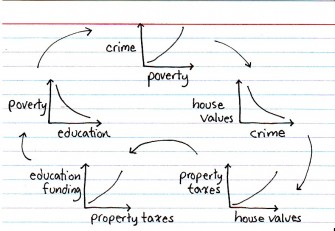
Some of the comments indicate that a missing (and erroneous) chart would be the one showing a correlation between education funding and education. And, of course, there's the matter of to what extent public-work-induced housing value increases have been reclaimed in public revenue.
Friday, October 8, 2010
As I'm sure you're aware...
From bakadesuyo:
My estimates imply that 8% of the rise in obesity between 1979 and 2004 can be attributed to the concurrent drop in real gas prices, and that a permanent $1 increase in gasoline prices would reduce overweight and obesity in the United States by 7% and 10%.
Wednesday, October 6, 2010

Check out Smart Growth America's criticism of the Travel Time Index:
the Travel Time Index actually gets daily driving backwards: cities with longer daily driving times look better that those with shorter driving times. Why? The Index leaves out something just about any traveler knows to think about: distance. By focusing only on speeds, the TTI neglects what people actually care about: how long does it take me to get there?
See the report at CEOs for Cities.
Monday, October 4, 2010
Economic Ideal, or Human Error.

One thing I suspect might be happening that wasn't discussed: people may not be great at calculating distribution in this way. Perhaps people should be asked as well, "What do you think the average individual's wealth is in this highest (or lowest) quintile to create this distribution?" It seems like a simple enough math problem, but through the course of this survey, it's likely participants weren't doing it. People have much greater familiarity with a concrete bank account price tag than they do with percent of the nation's wealth controlled.
This is not, however, an argument for the status quo. At the very least, the report does indicate that people want much more equitable distribution than they think we have, even as that is far less equitable than what we actually have!
Saturday, September 4, 2010
Sunday, August 8, 2010
Democracy vs. Constitutional Democracy
Not really on subject here, but this video discusses minority rights in the face of majority opinion. When Truman ordered the racial integration of the military, most in the military were against it, and that didn't matter; our constitution protects the rights of minorities.
Saturday, August 7, 2010
David Harvey, Capitalism, and a Dry Erase Board
An entertaining video about how our current version of capitalism is failing.
Friday, August 6, 2010
The Lasting Impact of Kindergarten
What's the effect of having a good kindergarten teacher? Common wisdom in social science is that it's nowhere near as important to the child's success as the education and socioeconomic status of the child's parents, but new research gives early education more importance. Based on a study in which students' kindergarten classes were randomized so that they "had fairly similar socioeconomic mixes of students and could be expected to perform similarly on the tests given at the end of kindergarten," similar scores were not found, nor were the students' futures similar:
source.
Class size — which was the impetus of Project Star — evidently played some role. Classes with 13 to 17 students did better than classes with 22 to 25. Peers also seem to matter. In classes with a somewhat higher average socioeconomic status, all the students tended to do a little better.
But neither of these factors came close to explaining the variation in class performance. So another cause seemed to be the explanation: teachers.
Some are highly effective. Some are not. And the differences can affect students for years to come.
When I asked Douglas Staiger, a Dartmouth economist who studies education, what he thought of the new paper, he called it fascinating and potentially important. “The worry has been that education didn’t translate into earnings,” Mr. Staiger said. “But this is telling us that it does and that the fade-out effect is misleading in some sense.”
Mr. Chetty and his colleagues — one of whom, Emmanuel Saez, recently won the prize for the top research economist under the age of 40 — estimate that a standout kindergarten teacher is worth about $320,000 a year. That’s the present value of the additional money that a full class of students can expect to earn over their careers. This estimate doesn’t take into account social gains, like better health and less crime.
source.
Thursday, August 5, 2010
Our Recession Continues...

Another thing that's different now as our liquidity trap: the Federal Reserve's interest rate is effectively zero, and there's little left for the Fed to do to stimulate the economy, thus we're left with financial stimulus from our government (effectively financed through debt to other government). Though media attention has been on those who think this debt is out of line, Hale Stewart at 538 has a lengthy argument for why that's not the case. Summarized:
- This new found love of lower government spending is politically motivated. It has nothing to do with altruism or love of country. It's about the November elections. Period.
- Government spending has been and always will be part of the the GDP equation
- Countries that tried austerity are worse off for it.
- Countries that inject massive amounts of the proper stimulus (such as infrastructure spending) grow at high rates.
Subscribe to:
Posts (Atom)

